|
Introduction Alzheimer's disease (AD) is a complex, progressive, and irreversible neurodegenerative disorder characterized by cognitive decline and memory impairment. The disease arises from dysregulation in multiple biochemical pathways and interacting neuronal systems, ultimately leading to neuronal dysfunction and degeneration [1-4]. It is estimated to affect approximately 36 million individuals worldwide and accounts for about 60–80% of all dementia cases [5]. One of the key therapeutic strategies for the management of AD involves the inhibition of acetylcholinesterase, an enzyme responsible for the breakdown of acetylcholine in the synaptic cleft. Drugs such as Donepezil, Rivastigmine, and Galantamine are commonly used as acetylcholinesterase inhibitors in the treatment of AD. Over the past century, herbal medicine has become an increasingly important component of healthcare systems worldwide [6]. Despite significant advances in modern pharmacotherapy, medicinal plants continue to play a vital role in disease management due to their accessibility, affordability, and diverse pharmacological properties [7]. Historically, plants have served as valuable sources of bioactive compounds with therapeutic potential, particularly as anti-infective agents and pharmacologically active seconddary metabolites [8]. Extracts, tinctures, and other preparations derived from plants and animals have long been used in traditional medicine to manage various human ailments. Consequently, natural products remain an important reservoir for drug discovery, and numerous plant-derived compounds have contributed significantly to modern therapeutics [9-13]. Given the continuing global burden of diseases such as cancer and HIV, the exploration of natural resources for bioactive compounds remains a critical area of research [14]. Cordia millenii (family Boraginaceae) is a tropical African forest tree widely distributed across several regions of the continent. The species can grow up to approximately 20 m in height, and in some regions such as Uganda, it may reach heights of about 40 m with a bole diameter of over 1 m [15,16]. In Nigeria, the plant is locally known as “omo” in the Yoruba language and “omah” in Benin, reflecting its cultural importance, particularly in the construction of traditional talking drums [17,18]. Beyond its economic importance in the timber industry, C. millenii has also gained attention for its extensive use in traditional herbal medicine [19-21]. Ethnomedicinally, different parts of C. millenii are used in [19] the treatment of a variety of ailments, including fever, cough, diarrhea, dysentery, toothache, stomachache, inflammation-related disorders, and parasitic infections [19,20,22-24]. In southeastern Nigeria, the seed powder mixed with palm oil is traditionally applied for the treatment of ringworm and itching [25]. In Cameroon and other West African countries, leaf decoctions are commonly administered to expel intestinal worms and to treat asthma, cough, and cold. Additionally, the flowers of C. millenii provide an important source of nectar and pollen for honeybees [26]. Previous studies have reported several biological activities of C. millenii extracts, including antimicrobial, antioxidant, and anti-infertility effects, as well as protective activity against lipopolysaccharide-induced neuroinflammation [16, 27-28]. Phytochemical investigations have revealed the presence of several classes of secondary metabolites in C. millenii, including sterols, triterpenes, and fatty acid derivatives. However, most studies have focused primarily on polar or moderately polar extracts such as methanol, ethanol, and ethyl acetate fractions. In contrast, non-polar extracts (e.g., n- hexane fractions) are known to contain a wide range of bioactive constituents such as fatty acid esters, terpenoids, sterols, and hydrocarbons. Despite this, the chemical composition of the non-polar constituents from the stem bark of C. millenii remains poorly characterized, representing a notable phytochemical knowledge gap. Furthermore, although C. millenii is widely used in traditional medicine for the management of pain, inflammation, and wound healing, its potential neuropharm- acological activity has not been extensively investigated. In particular, little information is available regarding the acetylchol-inesterase inhibitory potential of its non-polar constituents. This is important because acetylcholinesterase inhibition remains a key therapeutic approach in the management of neurodegenerative disorders such as AD. Moreover, currently available synthetic acetylcholinesterase inhibitors, including Tacrine, Donepezil, Rivastigmine, and Galantamine, used for the treatment of cognitive dysfunction and memory impairment associated with Alzheimer’s disease, are often associated with adverse effects such as gastrointestinal disturbances, hepatotoxicity, and limited long-term efficacy. Consequently, there is increasing interest in identifying plant-derived acetylchol-inesterase inhibitors as safer and more accessible and effective therapeutic alternatives [29], particularly in regions where medicinal plants constitute an essential component of primary healthcare. Although C. millenii is widely recognized in African ethnomedicine, comprehensive scientific validation of its bioactive constituents and mechanisms of action remains limited. Therefore, the present study investigated the chemical composition and in vitro acetyl-cholinesterase inhibitory activity of the n-hexane extract of the stem bark of C. millenii in order to substantiate its traditional medicinal applications and identify potential bioactive compounds of pharmacological interest.
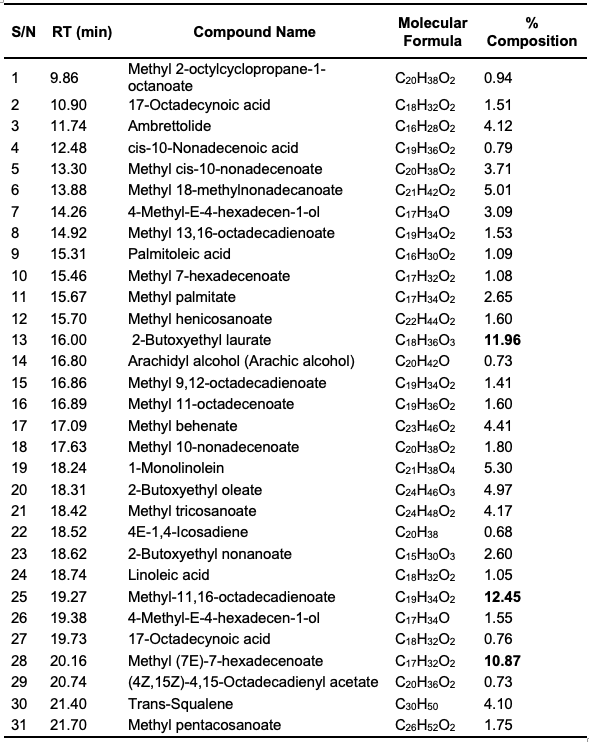
Experimental Plant Materials Preparation The stem bark of Cordia millenii tree was collected from Ekiti State, Nigeria and authenticated in the herbarium at the Department of Plant Biology, University of Ilorin, Ilorin, Nigeria. The stem bark was chopped into bits and dried at room temperature to remove moisture, weighed, and extracted with n-hexane for 5 days with intermittent changing of the solvent. The crude extract obtained was filtered, concentrated, and stored in sample vials in a cool dry place for further work. Gas Chromatography–Mass Spectroscopy (GC-MS) Analysis The chemical composition of the hexane extract of Cordia millenii stem bark was obtained by subjecting it to Gas Chromatography–Mass Spectrometry (GC-MS) analysis. Approximately, 0.2 g sample was diluted in 2.0 mL using hexane for stock solution and further to a microgram unit before injection into the Shimadzu GC-2010 gas chromatograph. The parameters for the analysis is as indicated: The detector, FID at 220°C, nitrogen gas flowing at 1.0 mL/min on a Optima 35 capillary column (30 m × 0.53 mm ID; 0.32 mm) with split ratio 1:30 and injector temperature, 250°C.The column temperature was maintained at 40°C for five minutes before increasing to 280°C (5°C/min) with a delay at that temperature for an additional five minutes. For the GC-MS, a Jeol JMS-HX 110 mass spectrometer with a source at 270°C and 70 eV coupled with a Hewlett-Packard 6890 gas chromatograph was used. The injector was con-figured to split at 1:30 and temperature at 270°C. Compound identification was estab-lished by comparing the MS fragmentation with authentic samples and data obtained on the NIST Library Version 3.0 mass spectral software database. The chemical composition of the hexane extracts, as obtained from the GC-MS, is as shown in Table 1.
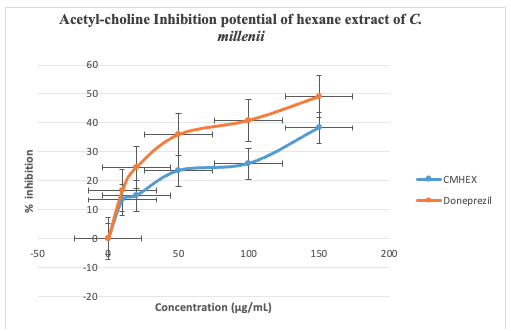
Acetylcholinesterase Inhibitory Assay (Ellman Method) Acetylcholine (ACh) is an important neurotransmitter that plays a critical role in memory and cognitive function. Acetylcholinesterase (AChE) is the enzyme responsible for the termination of nerve impulse transmission at cholinergic synapses through the rapid hydrolysis of acetylcholine. Consequently, inhibition of AChE has become an important therapeutic strategy for the management of several neurological disorders, including Alzheimer's disease, senile dementia, ataxia, Myasthenia gravis, and Parkinson's disease. The anti-cholinesterase activity of Cordia millenii extract is as shown in Figure 1.
The acetylcholinesterase (AChE) inhibitory activity of the extract was determined using the colorimetric method developed by George L. Ellman with minor modifications. This assay is based on the enzymatic hydrolysis of acetylthiocholine iodide by acetylcholinesterase to produce thiocholine, which subsequently reacts with 5,5′-dithiobis-(2-nitrobenzoic acid) (DTNB) to yield the yellow-colored 5-thio-2-nitrobenzoate anion. The intensity of the yellow color formed is directly proportional to enzyme activity and is measured spectrophotometrically at 412 nm. The enzyme used in the assay was acetylcholinesterase obtained from electric eel (Electrophorus electricus). The reaction mixture consisted of 200 µL of 0.1 M phosphate buffer (pH 8.0), 20 µL of the test extract, and 20 µL of the enzyme solution (0.5 U/mL). The mixture was pre-incubated at 25 °C for 15 min. Thereafter, 10 µL of DTNB (3 mM) and 10 µL of the substrate Acetylthiocholine iodide (15 mM) were added to initiate the reaction. The change in absorbance was monitored at 412 nm using a UV–visible spectrophotometer.The percentage inhibition of AChE activity was calculated using the equation:
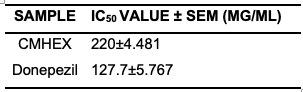
where Acontrol represents the absorbance of the control reaction (without extract) and Asample represents the absorbance in the presence of the extract. The standard inhibitor Donepezil was used as the positive control. All experiments were performed in triplicate (n = 3), and results were expressed as mean ± standard deviation (SD). The IC50 value (Table 2) represents the concentration required to inhibit 50% of acetylcholinesterase activity, where a lower The IC50 indicates greater inhibitory potency. The reference drug Donepezil, a well-established acetylcholinesterase inhibitor used in the management of Alzheimer's disease, exhibited significantly higher inhibitory potency compared with the hexane extract of Cordia millenii (CMHEX). Although CMHEX showed lower activity than the standard drug, it demonstrated measurable inhibition of acetylcholinesterase, indicating the presence of bioactive constituents capable of interacting with the enzyme.
The observed activity may be attributed to the combined effects of multiple phytochemicals present in the extract, which may act synergistically to produce enzyme inhibition. Such synergistic interactions are commonly reported in plant extracts, where complex mixtures of compounds contribute collectively to the observed biological activity. Although the inhibitory effect of CMHEX was weaker than that of Donepezil, the findings suggest that the non-polar constituents of C. millenii may possess potential neuropharmacological relevance. Further studies involving isolation of the active compounds, mechanistic evaluation, and comprehensive pharmacological and toxicological investigations are required to fully establish their therapeutic potential in the management of neurodegenerative disorders.
Discussion The medicinal properties of plants depend on the chemical substances (phytochemicals) that have a particular physiological action on the human body. These phytochemicals possess the potential to prevent and cure the harmful effects of germs and free radicals in the human body. Results from the GC-MS analysis carried out showed the presence of 31 compounds in the n-hexane extract of Cordia millenii (Table 1). The analysis revealed a complex mixture of fatty acids, fatty acid esters, alcohols, terpenoids, and hydrocarbons, which accounts for 100% of the total extract composition. The predominance of lipophilic compounds suggests that the extract is chemically aligned with other bioactive plant oils known for pharmacological properties. Among the identified compounds, methyl-11,16-octadecadienoate (12.45%), 2-butoxyethyl laurate (11.96%) and methyl (7E)-7-hexadecenoate (10.87%) were the most abundant. These unsaturated fatty acid esters are reported to possess antioxidant, antimicrobial, and anti-inflammatory activities, which may contribute to the ethnomedicinal uses of Cordia millenii. Other notable esters such as methyl-18-methylnonadecanoate (5.01%), 2-butoxylehyl oleate (4.97 %), and methyl tricosanoate (4.17%) further reinforce the antioxidant potential of the extract, as unsaturated fatty acid derivatives have been associated with radical scavenging and cytoprotective effects [30]. Lipid-derived compounds and fatty acid derivatives have also been shown to exhibit acetylcholinesterase inhibitory activity and potential neuroprotective properties in recent studies [31]. In addition, the presence of ambrettolide (4.12%) and 1-monolinolein, (5.30%) highlights the extract as a reservoir of macrocyclic lactones and monoacylglycerols, which are compounds with known antimicrobial and anti-inflammatory relevance. Similarly, long-chain alcohols such as 4-methyl-E-4-hexadecen-1-ol and arachic alcohol were detected. Fatty alcohols often exhibit emollient and protective roles in plants, suggesting possible applications in dermatological formulations. Most importantly, the extract contained trans-squalene (4.10%), a triterpene hydrocarbon recognized for its wide biological roles including antioxidant, anticancer, and cholesterol-lowering activities [32]. The detection of squalene in the extract strengthens the potential therapeutic value of Cordia millenii, particularly in oxidative stress-related conditions. Although some constituents such as methyl palmitate (2.65%), methyl behenate (4.41%), and linoleic acid (1.05%) were present in lower proportions, their combined activities could synergistically contribute to the pharmacological efficacy of the extract. The overall chemical profile, dominated by unsaturated fatty acid esters, aligns with the reported activities of Cordia species as traditional remedies against microbial infections and inflammatory disorders. Furthermore, plant-derived metabolites such as alkaloids, flavonoids, terpenoids, and fatty acid derivatives have been widely investigated as potential cholinesterase inhibitors due to their ability to modulate cholinergic neurotransmission. Recent reviews [33] have highlighted the increasing interest in natural products as sources of acetylcholinesterase inhibitors for the management of neurodegenerative disorders such as Alzheimer's disease, particularly because synthetic inhibitors may produce undesirable side effects [34]. The identified compounds possess many biological properties and moderate acethylcholinesterase activity when compared with the standard, Donepezil. The n-hexane extract of Cordia millenii stem has been found to exhibit reasonable cholinesterase inhibitory ability which makes it useful in the treatment of inflammations, dementia (memory loss and mental changes) associated with mild, moderate, or severe Alzheimer’s disease and other disorders. Cordia millenii exhibits significant AChE inhibitory activity.
Conclusion The results of this study provided an insight into the properties of the extracts of Cordia millenii used traditionally for the treatment of various inflammatory diseases. The GC-MS revealed that the n-hexane extract of Cordia millenii stem bark demonstrates a rich chemical composition dominated by unsaturated fatty acid esters and terpenoids, which are compounds well recognized for their antioxidant, antimicrobial, and cytoprotective properties. These findings provide a chemical basis for the traditional use of the plant in ethnomedicine and justify further pharmacological evaluation to confirm its bioactivities. The presence of all the secondary metabolites showed that Cordia millenii stem bark extractcould be used in the management of various inflammatory diseases. Therefore, further investigation is highly recommended. The chemical composition of the Cordia millenii hexane extract highlights its versatility and potential for various applications, which not only supports its traditional uses, but also opens up new possibilities in modern industries, especially in pharmaceuticals.
Conflict of Interest: Authors declare no conflict of interest.
References
|
||||||||||||||||||||||||