|
Introduction The composite materials, based on unsaturated polyester resin (UPR), have been widely used because of the good combination of mechanical performance, ease of processing and cost-effectiveness. The UPR has a satisfactory mechanical strength and a good chemical resistance, making it an ideal matrix for reinforced composite systems [1,2]. It has been demonstrated that mechanical properties like tensile strength, compressive resistance and hardness can be significantly improved when metallic fillers, particularly aluminum particles or flakes, are added to polymeric matrices. Aluminum fillers are very rigid and thermally stable, which allows better transfer of load between the reinforcement and the matrix [3,4]. Aluminum reinforcement effectiveness is strongly influenced by particle size, shape and quality of dispersion in the polymer matrix [5,6]. Aluminum particles restrict the movement of polymer chains, thus increasing the stiffness of the polymer chains. This improved the material's ability to withstand deformation stress. Furthermore, the enhanced interfacial bonding between the aluminum fillers and polyester matrix prevents crack propagation, thereby increasing the fracture resistance [7-9]. However, excessive use of filler contents can lead to agglomeration of particles which can create stress concentration zones that affect negatively the mechanical performance of the composite [10-12]. To evaluate such mechanical improvements in a comprehensive manner, it is necessary to define clearly certain parameters. Hardness, usually defined as the resistance of a material to localized plastic deformation (especially indentation or scratching of the surface), is an important measure of the durability of a composite surface. Shore hardness is highly relevant for polymeric composites where a durometer measures the depth of an indentation under a given load, thus providing a quick, non-destructive and standardized measurement of surface stiffness that is particularly sensitive to the addition of stiff metallic fillers such as aluminum . Moreover, the Young’s modulus is employed to measure the composite overall stiffness, and it is also defined as the specific modulus, defined as the ratio of tensile stress to tensile strain in the linear elastic deformation region. The direct incorporation of aluminum flakes influences the Young’s modulus by limiting the mobility of the polymer chains and consequently, enhancing the resistance of the material to elastic deformation under applied forces. In addition to the mechanical improvements, the thermal behavior of UPR composites is also highly affected by the aluminum reinforcement . In the composite structure, aluminum particles act as heat-dissipating elements, which slows down the thermal degradation and improves the overall thermal stability. The temperature window relevant for the aluminum powder spans from the processing and curing temperatures (approx. 25°C to 120°C) to the thermal degradation testing thresholds (up to 600°C or 800°C). The entire range is thermally stable with the aluminum powder without phase change because of its melting point of about 660°C. In contrast, the thermal degradation of unsaturated polyester matrix is generally observed in the temperature range 200°C to 450°C. Previous thermogravimetric analysis (TGA) results indicated that the aluminum-filled polyester composites exhibited higher decomposition onset temperatures than the neat polyester resin [13-16]. The optimal filler concentration that provides the mechanical improvements without losing the structural homogeneity is a key factor to determine the overall performance of these composites [17–19]. It has been indicated that the moderate aluminum loading yields the best mechanical and thermal properties, while the excessive loading may result in the loss of the composite integrity due to the poor dispersion of the fillers [20-23]. The present work investigates the effect of waste aluminum foil flake powder on mechanical and thermal properties of unsaturated polyester composites. To assess these properties, several composite samples were prepared with different concentrations of the aluminum waste powder, and a series of mechanical and thermal tests were carried out. The main objective of this study is to find the optimum filler loading that improves the performance as well as support sustainable recycling of aluminum waste. The results of this study will contribute to the development of high performance, cost effective and environment friendly composite materials.
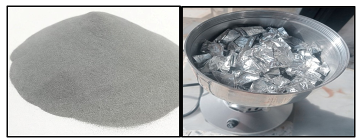
Matrix Material The Base Material and Hardener Unsaturated polyester resin (UPR) was chosen as the base material in this study due to its suitable viscosity, high compatibility with reinforcing fillers, and ability to harden at room temperature without requiring high temperatures. Thanks to these properties, unsaturated polyester resin can be used in the production of polymer-based composite materials. The unsaturated polyester resin used in this study was low viscosity, with an approximate density of 1.2 g/cm3. This resin was manufactured by Kamivar Resins (CE-80, Turkey). Methyl ethyl ketone peroxide (MEKP), a transparent hardener, was used as a liquid resin hardener at a rate of 0.6 g/100 g of resin. The hardening process began after approximately thirty minutes at room temperature, where the resin gradually transformed into a gel-like substance. It was then poured into molds to fully harden. Reinforcement Material Aluminum foil waste was ground using an industrial mill. It was then sieved using a 200-mesh sieve with a size of 75 microns to obtain a perfectly pure and fine powder, as shown in Figure 1.
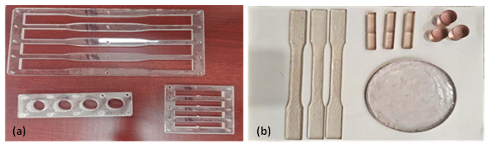
Preparation Method Several molds were designed and manufactured with dimensions and shapes suitable for the requirements of the equipment used to study mechanical properties such as tension, impact, compression, etc. The mold walls were coated with petroleum jelly to allow for the removal of samples from the molds after hardening without damage. The molds were fixed horizontally on a glass base covered with greaseproof paper to prevent the samples from sticking to the base and to obtain dimensionally symmetrical samples. A quantity of unsaturated polyester was weighed for all the molds, and a hardener was added at a rate of 2%. The mixture was stirred slowly for 2-3 minutes, then the polymer was poured into the molds and left to harden for 24 hours at room temperature. The process was repeated for each percentage of aluminum powder added. To study the effect of heat treatment on the prepared samples, the samples were subjected to different temperatures (150, 50, 25, and 7°C) for 24 hours (Figure 2).
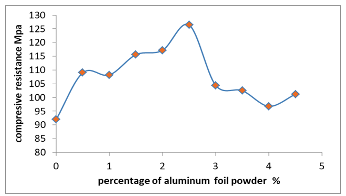
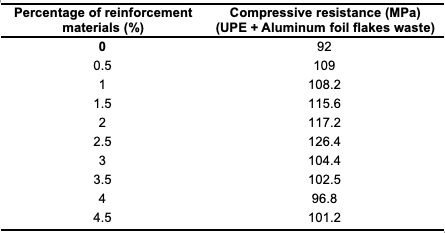
Results and Discussion The graph shows how the content of aluminum foil flake waste powder on the compressive strength of unsaturated polyester is influenced (Table 1 and Figure 3). The compressive strength attains great heights of about 92 MPa, then reaches a peak of about 127 MPa at 2.5% aluminum power.
The strength then decreases gradually with an increase in the powder content. This is explained by the fact that incorporation of fine particles of aluminum increases the capability of the material to resist stresses caused by even distribution of the metal particles in polymer and also, due to the development of effective chemical and physical bonds. But after the optimum percent (2.5), the particles are agglutinated and agglomerated, breaking the internal composition of the composite material and hence, compromising its compressive strength [24].
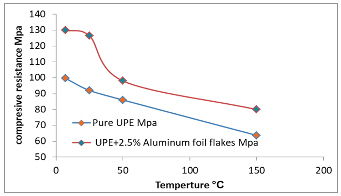
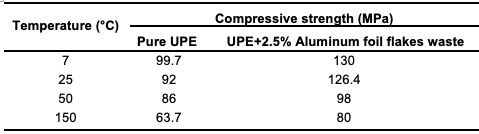
The graph is a comparison between the compressive strength of pure unsaturated polyester (UPE) and the composite material that is reinforced with 2.5% aluminum foil flakes waste in a vast temperature span (Table 2 and Figure 4). The curves clearly show that the mechanical properties of both materials are negatively affected by increasing temperature, with compressive strength gradually decreasing as the temperature rises.
However, the composite sample exhibits significantly higher performance and efficiency than the pure sample at all measured temperatures. The composite also displays a high compressive strength of approximately 130 MPa at lower temperatures, compared to 100 MPa for the pure sample. At temperatures up to 150°C, the reinforced sample exhibits a higher value (approximately 80 MPa) than the pure sample, whose strength drops to approximately 64 MPa. This superior mechanical performance of the composite material at high temperatures is attributed to the effectiveness of the aluminum foil as a more thermally stable reinforcing material than the polymer matrix. This foil withstands some of the pressures that have been introduced and prevents the movement of polymer chains in the form of a chain of material due to thermal energy, thus slowing down the softening process of the material, increasing the structural integrity of the material up to high thermal and mechanical loading [25].
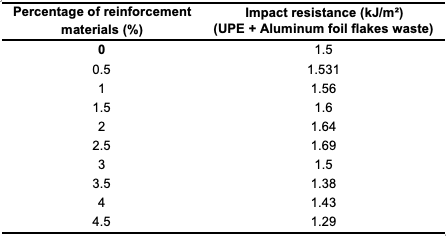
The graph illustrates the relationship between the percentage of aluminum foil powder added to unsaturated polyester and the impact resistance of the devices, measured in kJ/m² (Table 3 and Figure 5). The impact resistance value starts at approximately 1.5 kJ/m² for the pure material (without the addition), then gradually increases with increasing powder content, reaching a peak of approximately 1.69 kJ/m² at a 2.5% aluminum powder concentration.
Beyond this optimum percentage, the value drops significantly to approximately 1.29 kJ/m² at a 4.5% concentration. This rise in the impact resistance up to 2.5% is due to the fact that the fine aluminum particles are capable of absorbing impact energy and spreading the stress uniformly throughout the polymer structure. This avoids the formation of cracks and increases the life of the composite material. These particles also serve as mechanical barriers and prevent crack growth and enhance the energy storage capacity and resistance to damage of the material. The downward arrow at the higher percentage is because of the greater concentration that results in the concentration of particles, formation of clusters that are crack initiation centers, loss of impact resistance, and reduction in overall structural performance of the material [26].
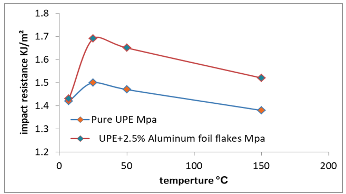
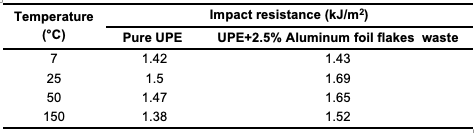
The comparative graph illustrates the impact resistance behavior of pure unsaturated polyester (Pure UPE) and a composite material reinforced with 2.5% aluminum foil flakes waste over a wide temperature range, from room temperature to 150°C (Table 4 and Figure 6).
The curves show that both materials also have an initial rise in impact resistance at lower temperatures and the composite material has its peak operational efficiency at about 1.7 kJ /m 2, while the pure material reaches approximately 1.5 kJ/m². However, the composite material consistently outperforms the pure material at all temperature points. When impact resistance reaches its peak, the impact resistance of both materials begins to gradually decrease with increasing temperature. The impact resistance of the composite material drops to approximately 1.52 kJ/m², while that of the pure material drops to approximately 1.38 kJ/m² at 150°C. This is because the high mechanical properties of the composite material result from the placement of the aluminum foil flakes waste, which enhances the material's ability to absorb and dissipate impact energy and prevents the propagation of micro-cracks in the polymer matrix. Furthermore, the heat softens the polymer matrix after reaching peak resistance, reducing the efficiency of the bonds and consequently decreasing the material's durability and ability to withstand impact loads [27].
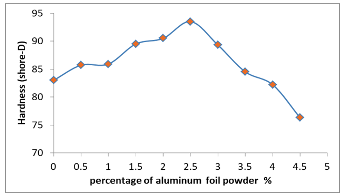
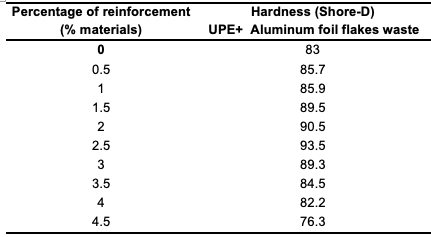
The graph illustrates the relationship between the percentage of aluminum foil flakes waste powder added to the unsaturated polymer and the Shore-D hardness value (Table 5 and Figure 7). The hardness value of the pure material (without the additive) starts at approximately 83, then gradually and steadily increases with increasing powder content, reaching a peak of around 93.5 at a 2.5% addition rate. Another important observation is that beyond this optimum percentage, there is a sharp and sudden drop in the hardness value to approximately 76 at a 4.5% addition rate. This is attributed to a 2.5% improvement in hardness due to the stiffness of the aluminum particles relative to the polymer matrix. The particles restrict the movement of the polymer chains, thus improving the surface's resistance to scratching and deformation. The sharp drop beyond the optimum percentage can be attributed to the effect of particle aggregation, where the material becomes homogeneous and the interfacial bond between the filler and the matrix weakens, creating weak areas and resulting in reduced hardness [28] .
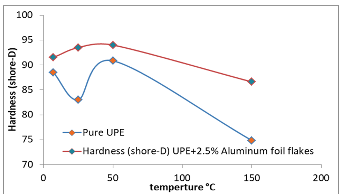
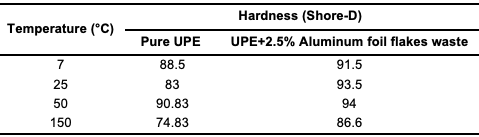
The behavior of two materials (pure unsaturated polyester (UPE) and a composite material containing 2.5% aluminum foil flakes waste, in terms of material stiffness (measured in Shore-D), over a temperature range from room temperature to 150°C (Table 6 and Figure 8), is plotted in a comparative graph.
The curves clearly show that the composite material significantly outperforms the pure material in maintaining its stiffness when exposed to heat. Although the pure sample exhibits changes in values at low temperatures (a decrease followed by an increase up to 50°C), a sharp and sudden drop in stiffness is observed after exceeding 50°C, reaching a minimum value of approximately 75 Shore-D at 150°C. The composite sample, on the other hand, is remarkably stable, reaching a maximum value of approximately 94 Shore-D at 50°C, followed by a gradual and moderate decrease to stabilize at approximately 86–87 Shore-D at 150°C. This is because the presence of solid aluminum foil flakes waste acts as a physical barrier, limiting the movement of the polymer chains. In this case, the thermal energy that would normally increase the movement of the polymer chains is limited, thus slowing down the thermal softening process. In contrast, high temperatures in the pure material temporarily separate the polymer chains and promote their movement, causing the polymer to rapidly lose its hardness and scratch resistance at temperatures above 150°C [29].
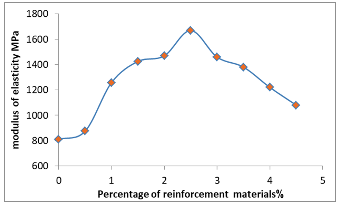
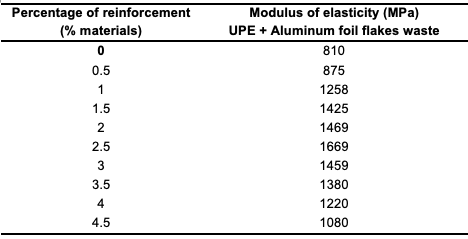
This graph illustrates the relationship between the added reinforcement percentage and the modulus of elasticity, measured in megapascals (MPa) (Table 7 and Figure 9).
The modulus of elasticity starts at approximately 800 MPa for the pure material (without reinforcement), then gradually increases, and then significantly, with increasing reinforcement percentage, reaching a maximum value of approximately 1700 MPa at a reinforcement percentage of about 2.5%. The modulus of elasticity then gradually decreases after this optimum percentage, reaching approximately 1100 MPa at a reinforcement percentage of 4.5%. The significant increase in the modulus of elasticity up to 2.5% is attributed to the high stiffness of the reinforcement material (aluminum foil flakes waste) compared to the polymer matrix, which enhances the material's resistance to elastic deformation under stress. These solid particles contribute to increasing the rigidity of the composite material, as it can withstand a large proportion of the load placed upon it, and reduce the maximum deformation of the polymer matrix. This decrease from the optimal ratio is attributed to the increased concentration, which leads to the clumping of particles and the lack of good homogeneous distribution, resulting in weak areas in the internal structure, in addition to a decrease in the efficiency of stress transfer between the filler and the matrix, and thus the overall modulus of elasticity [30].
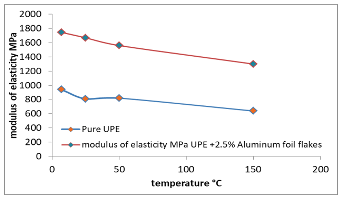
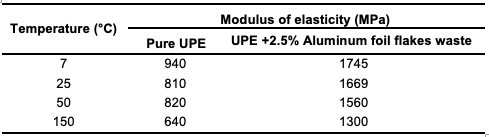
The following comparative graph illustrates the modulus of elasticity (stiffness) behavior of pure unsaturated polyester (Pure UPE) and a composite material reinforced with 2.5% aluminum foil flakes waste at temperatures ranging from room temperature to 150°C (Table 8 and Figure 10).
The curves clearly demonstrate the significant mechanical advantage of the composite material compared to the pure material at all tested temperatures. The modulus of elasticity of the composite starts at a high value of approximately 1750 MPa, nearly double that of the pure material, which starts at around 950 MPa. The values of both samples gradually decrease with increasing temperature, reaching approximately 1300 MPa for the composite and around 650 MPa for the pure material at 150°C. This marked superiority in the modulus of elasticity of the composite is attributed to the rigidity of the aluminum foil flakes waste, which significantly enhances the material's strength, thus improving its resistance to elastic deformation under loads. The foil also restricts the movement of the polymer chains, even at high temperatures. This gradual decrease in values with increasing temperature can be explained by the fact that time and temperature cause the polymer matrix to soften thermally, as the polymer chains gain additional kinetic energy, thus reducing the overall stiffness of the material. However, the addition of metal fillers reduces this decrease and preserves the properties of the composite material [31].
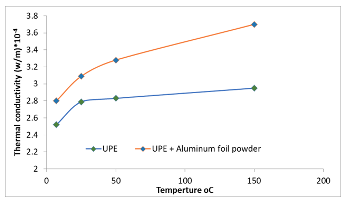
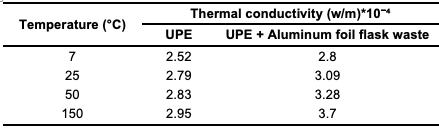
This graph compares the thermal conductivity, in watts/m² × 10⁻⁴, of pure unsaturated polyester (UPE) and a composite material made of pure unsaturated polyester reinforced with aluminum foil powder (UPE + aluminum foil powder) over a temperature range from room temperature to 150 °C (Table 9 and Figure 11). The curves clearly show that the composite material has significantly higher thermal conductivity values than the pure material at all tested temperatures.
At room temperature, the thermal conductivity of the reinforced composite is approximately 2.8 × 10⁻⁴ W/m², compared to 2.5 × 10⁻⁴ W/m² for the pure material. This variation rises up to 150 o C where the thermal conductivity of the composite material has attained about 3.7 x 10⁻⁴ W/m, in contrast to 2.95 x 10⁻⁴ W/m in the pure material. This massive enhancement in the thermal conductivity of the composite can be explained by the fact that the aluminum foil flakes waste is metallic in nature and has a far greater thermal conductivity compared to the polymer matrix which is an insulator. This foil serves as a heat conductor in the material and makes the thermal energy flow through the polymer material easier. Moreover, the thermal conductivity was higher with high temperature simply because the thermal activity of the molecules is also higher, thereby improving the transfer of energy. The composite material has enhanced thermal performance thus being applicable in applications that need effective heat dissipation [32].
The Fourier transform infrared (FTIR) spectrum reveals characteristic absorption peaks for the chemical structure of pure unsaturated polyester and the sample reinforced with 2.5% aluminum foil flakes waste powder (Figure 12). The peaks at 2926–2958 cm⁻¹ represent the tensile vibrations of the CH bonds, while a high peak at 1716–1732 cm⁻¹ is found in the carbonyl (C=O) group of the ester group.
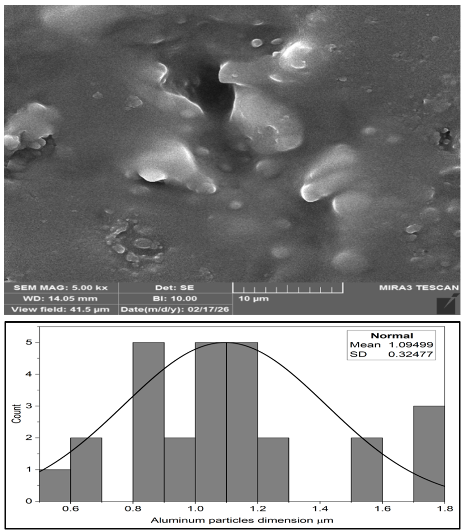
Other peaks are found at 1253 cm⁻¹ for the C–O bond, at 1448–1456 cm⁻¹ for the bending vibrations of the C–H bonds, in the region of 1068–1124 cm⁻¹ for the C–O–C bonds, and finally, the spectrum at 707–879 cm⁻¹ is attributed to the aromatic rings. Comparing the two spectra, it is clear that the main absorption peaks are exactly the same in both the pure sample and the composite material, and no new peaks were observed, indicating that the addition of aluminum foil flakes waste powder did not change the chemical composition of the polymer, and that the reaction was carried out through physical interactions between the filler and the polymer matrix without changing the structural integrity of the material [33]. The distribution of aluminum particles in the polymer structure was investigated using scanning electron microscopy (SEM) images of an unsaturated polyester structure reinforced with aluminum foil flakes waste powder (Figure 13). The images show the size of the aluminum particles distributed across the entire surface of the material.
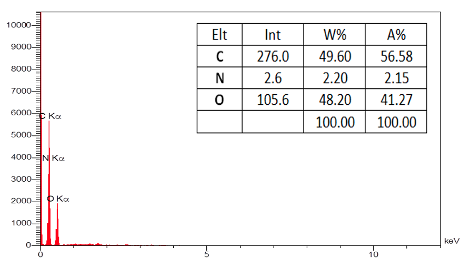
The particle size distribution was statistically analyzed to predict the lateral distribution, with an average particle size of 1.09 mm and a standard deviation of 0.32, falling within the range of approximately 0.6 mm to 1.8 mm. It is also indicated in the images that there are changes in the distribution of the particles, hence the agglomeration in some regions, which can influence the mechanical properties of the composite material. Moreover, the contact between the polymer matrix and the particles of aluminum can be observed, which is essential to transfer stress and increases mechanical properties. The observation that the particles were partially homogeneous will enhance the level of reinforcement and the overall mechanical performance of the composite material [34]. Energy-Dispersive X-ray spectroscopy (EDX) analysis of unsaturated polyester reinforced with 2.5% aluminum foil flakes waste powder can be used to determine the elemental composition of the composite material (Figure 14).
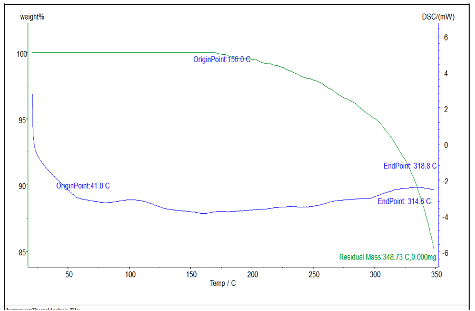
The results show three main components: carbon (C) at 49.60% wt. and 56.58% atomic mass, oxygen (O) at 48.20% wt. and 41.27% atomic mass, and nitrogen (N) at 2.20% wt. and 2.15% atomic mass. The high percentages of carbon and oxygen indicate that the unsaturated polyester is a chemical compound composed of hydrocarbon chains and oxygen-containing ester groups. Trace amounts of nitrogen may be present, which could be explained by impurities or additives introduced during the manufacturing process. It should also be noted that the low aluminum content at the time of analysis may be due to the low percentage of aluminum added (2.5%), which may be below the detection threshold of the instrument used [35]. The thermogravimetric analysis (TGA) curve shows the thermal properties of unsaturated polyester reinforced with 2.5% aluminum foil flakes waste powder over a temperature range up to 350°C (Figure 15). The curve exhibits remarkable thermal stability up to the starting point at 156.0°C, where the composite begins to experience gradual weight loss.
The thermal decomposition process can be divided into three main stages: the first stage (41–156.5°C), characterized by slight weight loss due to moisture evaporation and solvent residue; the second stage (156–318.8°C), the main thermal decomposition stage, where significant weight loss occurs due to the dissociation of polymer chains and the destruction of ester groups; and the final stage, completed at the endpoint (318.8°C). The results show that the final residue mass was 0.000 mg at 348.73°C, indicating complete decomposition of the organic material. This is because the presence of aluminum molecules in the composite material gives it relative thermal stability. These molecules serve as a thermal barrier and slow down the transfer of heat and restrict the movement of the polymer chains. This, respectively, postpones the breakdown of thermal degradation and increases the thermal resistance of the composite material. The differential thermal scanning (DSC) curve demonstrates the change in the heat flux (DSC/mW) of the composite material as a function of the temperature, which implies the physical and thermal transformations that take place in the composite material. The point where the curve starts is 41.0°C, the glass transition temperature (Tg) of the composite material, the point at which the material changes into a not-so-solid, more flexible and elastic one. Heat flux changes were recorded at approximately 314.8°C (the endpoint) between the main thermal and chemical decomposition reactions of the polymer. The overall shape of the curve indicates relative thermal stability within the intermediate temperature range (50–150°C), after which the heat flux gradually decreases as the temperature approaches the decomposition region. The presence of aluminum molecules in the polymer structure influences the heat flux behavior. It impedes the movement of polymer chains and alters the degree of glass transition, but it improves the thermal and mechanical properties of the composite material when exposed to different operating conditions [36].
Conclusion The current paper indicates that waste in the form of aluminum foil flakes reinforcing filler is a highly appropriate material in improving the mechanical and thermal characteristics of unsaturated polyester resin (UPR) composites, with the best concentration of reinforcement being 2.5 wt.%. Compressive strength (increasing by a factor of 2.2), impact resistance (1.5 to 1.69 kJ/m2), Shore-D hardness (83 to 93.5), and modulus of elasticity (810 to 1669 MPa) at 25°C and increased thermal conductivity values (3.7 x 10³ W/m at 150°C versus 2.95 x 10³ W/m, unreinforced matrix) were significantly improved at this. The enhancements in high temperature (7°C-150°C) can be explained by the high rigidity and thermal stability of aluminum flakes which serve as an effective coating with regard to inhibiting the mobility of polymer chains and slowing down the process of thermal softening. The techniques of characterization, such as FTIR, SEM, EDX, TGA, and DSC, proved the fact that the reinforcement took place mainly because of physical interactions without changing the chemical structure of the polyester matrix, and agglomeration of the particles above the optimal loading percentage led to a decrease in the properties due to the lack of strong bonds between the particles and concentration sites.
Acknowledgment I extend my sincere thanks to the University of Mosul and the College of Education for Women for their support in completing the research.
References
|
||||||||||||||||||||||||||||||||||||||||||||||||||||||||||||||||||