|
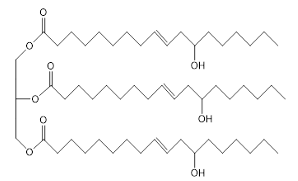
Introduction Natural plant oils have gained increasing attention in modern skincare due to their rich lipid content and ability to enhance skin hydration, barrier function, and overall health [1]. Lipids serve a central role in skincare due to their ability to enhance skin hydration, support barrier integrity, and deliver bioactive compounds beneficial to skin health [2]. The effectiveness of any plant oil in cosmetic applications is largely determined by its fatty acid composition, as fatty acids influence the emolliency, absorption rate, stability, oxidative resistance, and compatibility of oil for different skin types [3]. Fatty acid profiling serves as a scientific tool for assessing the quality, stability, and suitability of oils used in skincare formulations [4]. Ricinus communis (castor) seed oil, the major source of the triglyceride, triricinolein (Figure 1), is a widely used natural lipid having been recognized in traditional medicine, pharmaceuticals, and cosmetic applications.
Extracted from the seeds of the castor plant, it is known for its high viscosity, glossy texture, and beneficial skin properties [5]. Castor oil is particularly unique because it contains an exceptionally high proportion of ricinoleic acid, a hydroxylated fatty acid responsible for its strong moisturizing, anti-inflammatory, and antimicrobial effects [6]. These characteristics make it a promising ingredient for developing skincare formulations targeted at improving skin hydration, soothing irritation, and enhancing skin barrier integrity. Castor bean oil, among all vegetable oils, is distinctive because of its high level of ricinoleic acid (over 85%), which is a fatty acid consisting of 18 carbons, a double bond between C9 and C10, and a hydroxyl group attached to C12 [7]. Despite its extensive use, scientific eval-uation of its fatty acid composition remains important to ensure consistency, detect adulteration, and optimize its application in evidence-based skincare products [8]. Hydrogenated castor oil and castor acids with melting points higher than the non-hydrogenated material are used in cosmetics [7]. The hydrogenated form is solid and has no harmful effect on the skin, so it is used as emulsifying agent in skin creams [9]. Castor oil is used as an emulsifier and non-ionic solubilizer which is produced by mixing ethylene oxide and castor oil [10]. Pomace is castor residue. It has a high amount of nitrogen and is used as animal feed and as organic fertilizer without any reported major harmful effects [11]. The leaves are used as food for silkworms and the stalks are used for fuel purpose in India [12]. Fatty acid profiling of Ricinus communis seed oil is essential for understanding its functional attributes and optimizing its use in formulation science [13]. It is performed using gas chromatography, provides detailed information on the lipid makeup of castor oil by identifying the types and proportions of fatty acids present. This analysis is vital because variations in fatty acid composition can arise due to differences in seed quality, geographic origin, and extraction methods [14]. Although castor oil has been widely utilized for various purposes, there is still limited research linking its lipid profile directly to the formulation performance of specific skincare products. This calls for a need to further investigate how Ricinus communis (Castor) seed oil composition influences formulation stability, absorption, and functional benefits when applied to the skin.
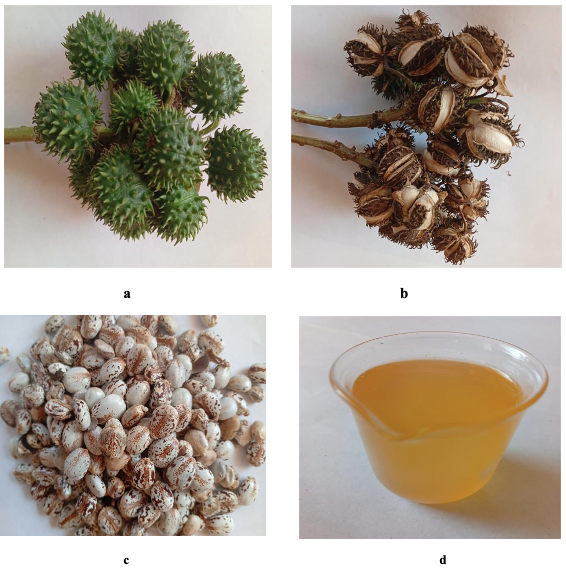
Experimental Chemicals and Materials The solvents and reagents used were analytical grade and were obtained from Sigma-Aldrich Chemical Limited and British Drugs House Chemical Ltd (BDH). These include methanol, ethanol, water, n-hexane, diethylether, hydrochloric acid, potassium hydroxide solution, phenolphthalein indicator, glycerine and tocopherols. Other materials such as virgin coconut oil, shea butter, honey, emulsifier, and beeswax were obtained locally in high quality. Castor seeds (Ricinus communis) were obtained from a farm in Ilorin South Local Government Area, Ilorin, Kwara State, Nigeria (Figure 2).
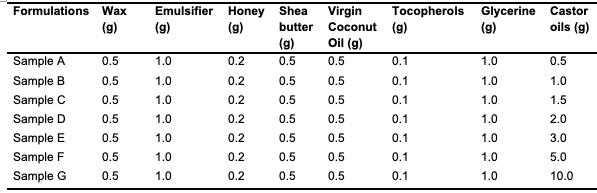
The plant sample was identified as Ricinus communis and documented in the herbarium at the Department of Plant Biology, University of Ilorin, Ilorin Nigeria. The seeds were obtained by removing the castor shaft and the castor coat, then air-dried for 24 hours and pulverized using electric blender. For the water extraction, the sample was roasted at moderate temperature for moisture reduction, easier pulverization and improved oil yield before it was pulverized. Solvent Extraction of Castor Seed Oil The pulverized castor seed was extracted cold with n-hexane for 5 days. The extract was then concentrated using rotary evaporator. The oil obtained was kept in a cool place for further analysis. Aqueous Extraction of Castor Seed Oil Water was added to the roasted pulverized castor seeds and was mixed thoroughly to disperse the paste until a runny consistency was obtained, after which it was heated for 50 minutes to loosen the oil from the thick paste. The paste was then strained to remove the castor seed residue, and the runny paste was then poured into a container with a fitted lid. It was placed in a freezer for 48 hours to allow the oil to separate out. The oil was collected over the aqueous paste and kept in a cool place for further work. Transesterification Castor seed oil (1 g) obtained via solvent extraction was treated with 100 mL of 0.1 M methanolic potassium hydroxide, which was then poured into a round bottom flask and refluxed for 30 minutes to hydrolyze and convert the lipid into methyl esters. The methyl ester formed was extracted with n-hexane and diethylether and washed with water in a separating funnel. It was allowed to settle down to form two distinct layers. The upper layer (Organic layer) was distilled, and the resulting oil was recovered. The process was repeated for the water extracted oil. Determination of the Physicochemical Properties of Ricinus communis (Castor Seed) Oil Both extracted oils were subjected to physicochemical evaluations following standard procedure [13]. Acid Value Test The acid value of the oil samples was determined by titration method. Castor seed oil (0.5 g) was dissolved in 50 mL solvent of equal volume of diethylether and ethanol. The solution was titrated with standardized 0.1 M potassium hydroxide solution using phenolphthalein indicator. The acid value was calculated using the formula (equation 1): where: M= molarity of standard potassium hydroxide KOH Castor seed oil (0.5 g) was weighed into a conical flask and 25 mL of methanolic potassium hydroxide was added. The solution was connected to a reflux condenser and boiled gently on a steam bath for 30 minutes. The hot solution was titrated against 0.5 M hydrochloric acid using phenolphthalein indicator to the end point when the pick colour disappeared. The saponification value was calculated using the formula (equation 2): where: SV= Saponification value Formulation of Skin Care Cream The recipes for the preparation of the organic cream contain components which included natural bee wax, emulsifier, honey, shea butter, virgin coconut oil, tocopherols and glycerine. First, the bee wax, emulsifier, honey, shea butter, virgin coconut oil, tocopherols, and glycerine was melted inside a beaker on a hotplate, which was followed by the addition of the hexane-extracted castor seed oil. The hexane-extracted castor seed oil was selected as a result of the presence of higher amounts of ricinoleic acid. The procedure was repeated using different amounts of castor seed (Ricinus communis) oil. The mixtures were poured into different containers for cooling, solidification and storage. The recipe (Table 1), indicated above, presents seven samples to systematically investigate the influence of castor oil concentration on the overall performance of a semi-solid topical formulation. In all samples, the quantities of wax, emulsifier, honey, shea butter, virgin coconut oil, tocopherols, and glycerine were kept constant, while the amount of castor oil was progressively increased from 0.5 g (Sample A) to 10.0 g (Sample G). This controlled approach allows for a clear evaluation of the specific contribution of castor oil to the physicochemical and functional characteristics of the formulation.
Wax (0.5 g) was included to impart structural rigidity and enhance the consistency of the formulation, while the emulsifier (1.0 g) ensured the formation and stability of the oil–water interface. Honey (0.2 g) and glycerine (1.0 g) served as humectants, promoting moisture retention and contributing to the hydrating properties of the formulation. Shea butter (0.5 g) and virgin coconut oil (0.5 g) acted as emollients, improving skin conditioning and barrier function. Tocopherols (0.1 g) were incorporated as antioxidants to enhance oxidative stability and protect the lipid components from degradation. Castor oil was selected as the variable component due to its high viscosity, ricinoleic acid content, and well-documented emollient and occlusive properties. The gradual increase in castor oil concentration across Samples A–G was expected to significantly influence the rheological behaviour, spreadability, and sensory attributes of the formulations. At lower concentrations (Samples A–C), the formulations are anticipated to exhibit lower viscosity, improved spreadability, and a lighter skin feel. Intermediate concentrations (Samples D–E) are likely to provide a balance between emolliency and acceptable sensory properties. In contrast, higher castor oil levels (Samples F–G) are expected to produce thicker, more occlusive formulations, which may enhance moisturization but could negatively impact spreadability and user acceptability. Furthermore, increasing the oil phase without a corresponding increase in emulsifier concentration may affect emulsion stability, particularly in formulations with high castor oil content. This variation is critical for determining the maximum castor oil concentration that can be incorporated without compromising formulation stability. The formulation design enables a systematic assessment of the role of castor oil in modulating the physical, functional, and aesthetic properties of the topical system, thereby facilitating the identification of an optimal composition for the intended application. Gas Chromatography Mass Spectroscopy Analysis The FAME obtained was subjected to Gas Chromatography-Mass Spectroscopy System with a GC, (Shimadu GC-2010) and S model (Shimadu MS-QP 2010). Fatty acid standards were first injected, and the calibration was kept for further analysis. Carrier gas (He) was used. Temperature was first maintained isothermally and then programmed to rise from 60 to 280°C. The flowrate was adjusted to 0.8 mL/min. The mass range of the mass spectrometer operates at 70eV ionisation energy and FAMES was identified by comparing the retention time with those of the authentic standard and further confirmed by comparing the mass fragmentation pattern with those of NIST library. Anti-inflammatory Evaluation: Albumin Denaturing Inhibition Assay The extracted castor seed oil was subjected to biological analysis (protein albumin denaturation). The reaction mixture (5 mL) of each of the formulations comprised of 0.2 mL of eggs albumin, 2.8 mL of phosphate buffered saline (PBS, pH 6.4) and 2 mL of varying concentration of extracts. A similar volume of double distilled water served as a control. Then, the mixture was incubated at 37°C in an incubator for about 15 mins and then heated at 70°C for 5 mins. After cooling, their absorbance was measured at 660 nm by using a pure blank. Diclofenac sodium (standard drug) was used as a reference drug and treated as such for the determination of absorbance. The percentage inhibition of protein denaturation was calculated by the formula (equation 3): Indomethacin was used as standard drug.
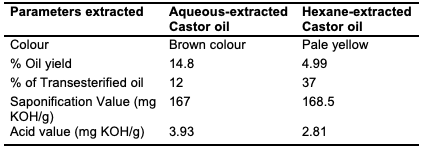
Results and Discussion Result of Physicochemical Properties of Ricinus communis Seed Oil The physicochemical parameters of the water and hexane-extracted oils are as presented in Table 2.
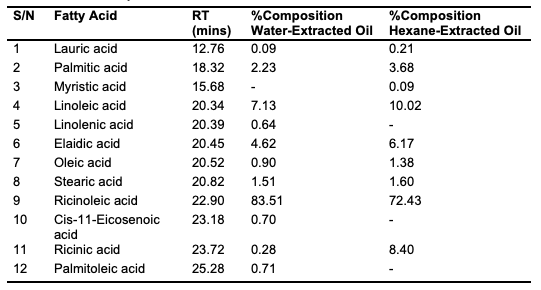
The physicochemical properties of castor oil vary significantly based on the extraction method employed. The comparison between virgin extracted and solvent extracted samples highlights differences in colour, yield, transesterification efficiency, and chemical indices. Water-extracted castor oil exhibits a brown coloration, while solvent extracted oil is pale yellow. The darker colour of the water-extracted oil may be attributed to the presence of natural pigments, residual seed coat materials, or higher levels of impurities retained during mechanical extraction. Solvent extraction produces lighter-coloured oils due to more efficient removal of pigments and impurities. Water-extracted extraction produced a higher yield (14.8%) compared to solvent extraction (4.99%). This suggests that adopted water extraction method is more effective in recovering oil from castor seeds under the conditions used. The lower yield from solvent extraction may be attributed to incomplete penetration of the solvent or losses during recovery. However, the solvent extracted oil showed a higher transesterification percentage (37%) compared to water-extracted oil (12%). This indicates that solvent-extracted oil is more amenable to conversion into biodiesel or other esters, possibly due to lower impurity levels and better accessibility of triglycerides to catalysts. Both oils exhibit similar saponification values (167 mg KOH/g for water-extracted vs. 168.5 mg KOH/g hexane-extracted). This suggests that the average molecular weight of fatty acids in both oils is comparable, and the extraction method does not significantly alter the fundamental triglyceride composition. Virgin oil has a higher acid value (3.93 mg KOH/g) compared to solvent oil (2.81 mg KOH/g). A higher acid value indicates greater free fatty acid content, which may result from hydrolysis during mechanical extraction or storage. The hexane extraction appears to produce oil with lower free fatty acid content, which is advantageous for industrial applications such as biodiesel production, where high acid values can interfere with transesterification. Gas Chromatography Mass Spectroscopy Analysis for Fatty Acid The two transesterified castor oils were subjected to GC-MS analysis. The fatty acid profile of each of the extracted oil are shown in Table 3.
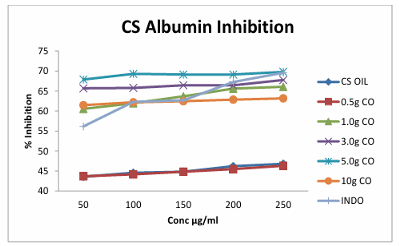
The fatty acids profile obtained from the GC-MS fragments reveals a distinctive composition dominated by ricinoleic acid (83.51%). This exceptionally high proportion is characteristic of castor oil and confirms the identity of the sample. Ricinoleic acid (commercial source of a hydroxylated fatty acid) is well-documented for its diverse pharmacological and industrial applications, including anti-inflammatory, antimicrobial, and laxative properties, as well as its role in the production of bio-based polymers, lubricants, and biodiesel. Its predominance in the sample emphasis the unique chemical nature of castor oil compared to other vegetable oils. Palmitic acid (2.23%), stearic acid (1.51%), and oleic acid (0.90%) are minor components that contribute to the saturated and monounsaturated fractions of the oil. Although present in small amounts, these fatty acids influence the physicochemical properties of the oil, including oxidative stability and melting behaviour. Trace amount of lauric, linolenic, cis-11-eicosenoic, ricinic, and palmitoleic acids (<1%) further highlight the chemical complexity of the sample. The presence of essential fatty acids, albeit in smaller proportions, suggests some nutritional relevance, but the oil’s primary value lies in its bioactive and functional properties. The fatty acids profile (Table 3) obtained from the GC-MS fragments of solvent-extracted castor seed oil revealed ricinoleic acid as the major constituent with amount, 72.43%. Ricinoleic acid (a hydroxylated C18 fatty acid) is unique among vegetable oils and is primarily responsible for the oil’s distinctive physicochemical and biological properties. Its abundance explains the wide industrial and pharmaceutical applications of castor oil, including its use in lubricants, coatings, cosmetics, and as a bio-based feedstock. Medicinally, ricinoleic acid is associated with anti-inflammatory, antimicrobial, and laxative activities, making it the defining constituent of castor oil. Secondary components include linoleic acid (10.02%) and ricinic acid (8.4%), both present in appreciable amounts. Linoleic acid contributes nutritional value and plays a role in maintaining membrane fluidity and cellular signaling. Ricinic acid adds chemical diversity, which may influence the oil’s functional properties. Elaidic acid (6.17%) also appears in notable proportion, reflecting unsaturation and potential structural isomerization during extraction or processing. Anti-inflammatory Evaluation Albumin denaturation is a widely accepted in vitro model for evaluating anti-inflammatory potential, as protein denaturation is a key event in inflammatory processes. Figure 3 illustrates the percentage inhibition of albumin denaturation by Ricinus communis (castor seed) oil and its formulated cream compared to the standard anti-inflammatory drug, indomethacin.
The result revealed that 10 g castor oil showed inhibition levels comparable to indomethacin, suggesting that castor oil at high concentrations possesses significant anti-inflammatory potential. This highlights the possibility of castor oils serving as alternatives to conventional synthetic drugs. Samples with castor oil concentrations 3.0 and 5.0 g castor exhibited a noticeable inhibition, reinforcing the dose-dependent trend. However, lower concentrations at 0.5 g and 1.0 g were largely ineffective. This suggested that therapeutic efficacy of castor oil may only be achieved at higher doses. The results indicate that both the crude castor oil and the formulated cream exhibit substantial inhibitory effects on albumin denaturation, suggesting strong anti-inflammatory properties. The inhibition percentages were comparable to, and in some cases approached, those of indomethacin, highlighting the therapeutic relevance of castor oil-based formulations. The high activity can be attributed to the presence of ricinoleic acid, the major fatty acid identified in the GC-MS analysis, which is known for its anti-inflammatory and analgesic properties. The dose-response relationship observed is consistent with pharmacological principles, where increased concentrations enhance biological activity until a plateau is reached. While high-dose castor oil shows promise and potential safety. A clear dose-dependent trend is observed across most samples, with inhibition increasing with increasing concentration. This aligns with pharmacological principles and underscores the importance of optimizing dosage for therapeutic applications. The findings suggest that the oil is a promising candidate for natural anti-inflammatory cosmetic formulations.
Conclusion The study successfully characterized the chemical constituents of Ricinus communis oil and demonstrated its potential for cosmetic and therapeutic applications. Through transesterification, the oil was converted into fatty acid methyl esters (FAME) and formulated into a cosmetic cream. GC-MS analysis revealed 11 distinct compounds in both water- and hexane-extracted oils, with ricinoleic acid identified as the predominant component. Notably, both the raw oil and the formulated cream exhibited significant anti-inflammatory activity, comparable to the standard drug indomethacin. These findings highlight Ricinus communis oil as a promising natural resource for developing anti-inflammatory cosmetic formulations and suggest its potential role in pharmaceutical and cosmeceutical industries.
References
|
||||||||||||||||||||||||||||||