|
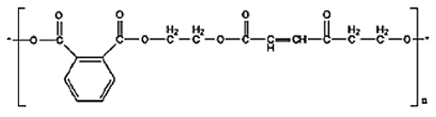
Introduction Composite materials are sophisticated engineering systems composed of two or more materials with different chemical and physical properties, mechanically bonded without fusion to produce a single material with enhanced functionality compared to the original materials used in its manufacture [1,2]. A composite material typically consists of two main components: a substrate, which is the bonding material that holds the other materials together and protects them from various external factors, and reinforcement, which is embedded in the substrate in the form of fibers, molecules, or sheets to bear the main mechanical loads [3]. Recent research efforts focus on developing sustainable composite materials based on natural fibers and biodegradable materials, as well as improving manufacturing methods to make them more economical [4-6]. Polyesters, in general, are synthetic polymers with a multi-purpose basic structure and consist of ester groups in the main chains of macromolecules. Polyesters are characterized by high tensile strength, exceptional stiffness, and resistance to abrasion and creep under static loads [7,8]. These materials also exhibit moderate elasticity, with elongation at break ranging from 15% to 30%, depending on the polyester type and the heat treatment used [9-11]. Therefore, they are suitable for use in various fields, such as textiles [12,13], packaging [14] and engineering applications [1 5 ]. Regarding thermal properties, unsat-urated polyesters exhibit different thermal characteristics due to the formation of cross-links during heat treatment (Figure 1) [1 6 ].
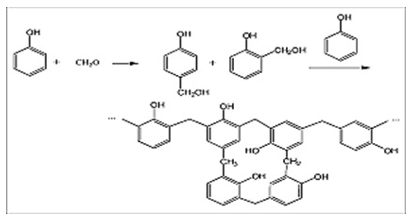
Novolac resins are an important class of thermoplastic phenol-formaldehyde poly-mers, prepared via an acid-catalyzed con-densation reaction between phenols and formaldehyde in a molar ratio of less than one [17]. The term "novolac" is derived from Latin and Swedish origins meaning "new varnish," reflecting its historical use as an alternative to natural varnishes such as cobalt resin [18]. These resins are characterized by a linear or partially branched structure, with methylene bridges (-CH₂-) forming between aromatic rings at ortho and para positions. The degree of branching depends on the reaction conditions and the ratio of monomers (Figure 2) [ 19 ].
Structurally, the polymer chain in novolac resins terminates upon complete formaldehyde consumption, resulting in a thermoplastic material incapable of self-crosslinking without the addition of an external crosslinking agent [ 21 ]. Novolac resins possess unique physical and chemical properties that make them suitable for precision engineering applications. These properties include an amorphous solid state at room temperature, a ductility range of 65–105°C, and solubility in polar organic solvents such as alcohols and acetone [2 1 ].
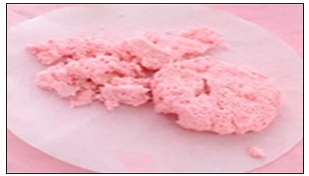
Experimental Materials Base material The reinforcing materials The reinforcement material is a formaldehyde resin (novolac). Phenol-formaldehyde polymer is prepared in an acidic medium with an excess of phenol, requiring a hardening agent such as hexamine to complete the polymerization and hardening process. In a glass flask, the following quantities of reagents were added: 2 g of phenol, 2.5 mL of formaldehyde, 1 mL of hydrochloric acid, and 5 mL of glacial acetic acid. The flask was covered to prevent the evaporation of volatile substances, and the solution was then heated gradually with continuous stirring for five minutes until the reaction was complete and a pink, solidified polymer was obtained (Figure 3).
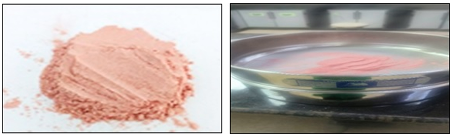
The resulting precipitate was then washed several times with distilled water to remove impurities and unreacted reagents and allowed to dry completely at room temperature. After complete drying, the polymer was ground using a grinder and mortar and then sieved through a standard sieve with 75 µm openings to obtain a pure powder with uniform particle size [ 23 ], as shown in the Figure 4 .
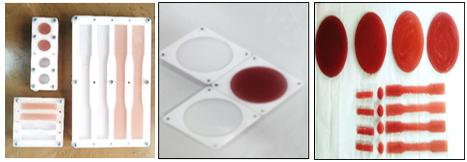
Sample preparation After preparing the Novolac, it was mixed with polyester in specific weight percentages (0.5%, 1.0%, 1.5%, 2.0%, 2.5%, 3.0%, 3.5%, 4.0%, 4.5%, 5.0%). Samples for mechanical property testing were then prepared by manual molding according to the requirements of each type of test [24], as shown in the Figure 5.
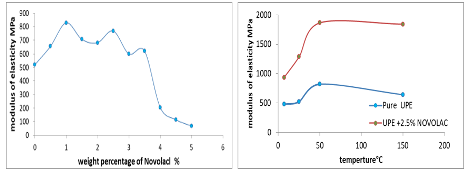
Results and Discussion The modulus of elasticity of unsaturated polyester resin (UPE) reinforced with varying proportions of novolac resin was measured. The results showed a significant increase in stiffness with the addition of novolac, peaking at 1% and 2.5% (approximately 830 MPa), respectively. However, slight fluctuations were then recorded, with a sharp decrease observed once the novolac content exceeded 3.5%. This indicates that the reinforcer ratio is optimal, and that excessive reinforcement may lead to phase separation or the formation of agglomerates, potentially weakening the polymer network [25] .
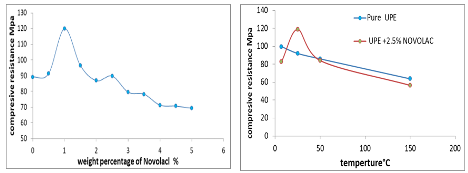
The modulus of elasticity of pure polyester was also compared with polyester reinforced with 2.5% novolac under the influence of different temperatures (Figure 6), and it was found that the reinforced polyester had a significant advantage as the modulus of elasticity doubled to about 1900 MPa at 50°C and remained stable at 150°C, while the unreinforced polyester showed less stability and lower values, confirming the role of novolac material in increasing crosslinking density and enhancing the thermal and mechanical stability of the composite material [ 26 ]. The compressive strength of unsaturated polyester resin (UPE) that had been reinforced with different percentages of novolac resin was determined. The samples recorded a considerable improvement, which reached their maximum of 1% (around 120 MPa) then gradually reduced with the percentage reaching 5%. This implies that the best reinforcement per-centage will be 1% since further rein-forcement may result in agglomeration or phase separation, which will make the structure weak . In the comparison of the thermal behavior of pure polyester to the sample that was reinforced with 2.5 percent novolac, pure polyester demonstrated the reduction in strength with increasing temperature whereas the reinforced sample demonstrated a peak in strength at low temperature (25°C), then decreased its strength very fast, making it to be lower than the pure polyester at high temperatures (150°C), as shown in Figure 7 [20].
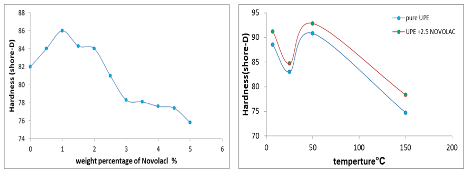
The Shore-D hardness properties of unsaturated polyester resin (UPE) reinforced with varying percentages of novolac resin were investigated. The hardness value gradually increased, reaching a maximum at 1% (approximately 86 Shore-D), indicating increased crosslinking at this percentage. The hardness then decreased with increasing novolac content, reaching its lowest value at 5%. This decrease is attributed to phase segregation or heterogeneity of the polymer mixture [2 7 ]. The hardness was also compared as a function of temperature for pure polyester and the sample reinforced with 2.5% novolac. The reinforced sample exhibited better hardness readings across the temperature range, demonstrating the effect of novolac on enhancing the material's thermal stability and resistance to rapid softening. The hardness peaked at approximately 93 Shore-D at 50°C and continued to decrease with increasing temperature [2 8 ], reaching its lowest value below 150°C, as shown in Figure 8.
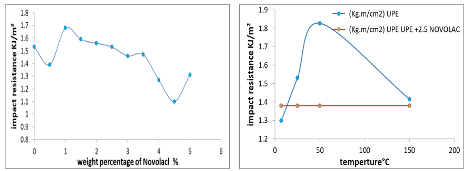
The impact resistance of pure unsaturated polyester (UPE) resin reinforced with varying percentages of novolac resin was studied. We observed an improvement in impact resistance, reaching a peak at 1% (approximately 1.7 kJ/m²), indicating that this percentage enhances the material's energy absorption capacity. However, increasing the novolac percentage beyond this point resulted in an overall decrease in resistance, with a sharp drop at higher percentages (4–5%). This is typically attributed to increased polymer network fragility or heterogeneity in the mixture .
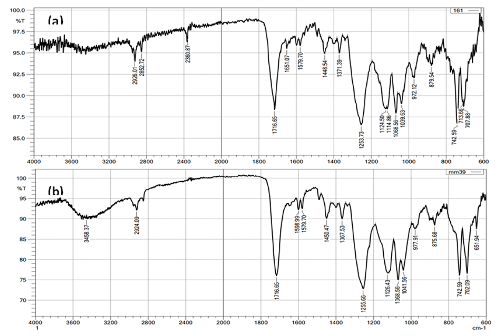
Regarding the thermal behavior of impact resistance between pure polyester and the sample reinforced with 2.5% novolac (Figure 9): pure polyester showed high sensitivity to temperature, rising sharply to a peak at 50°C before decreasing again, while the reinforced sample showed remarkable stability and consistency in shock resistance values across the thermal range (from 0 to 150°C) without being greatly affected by the rise in temperature, although its values were lower than the peak achieved by pure polyester at 50°C. The chemical structures of the neat (unreinforced) unsaturated polyester and the sample containing 2.5% novolac were compared by Fourier Transform Infrared (FTIR) spectroscopy (Figure 10). Direct comparison shows that the incorporation of novolac leads to significant changes in the structure, as evidenced by the appearance of a number of new distinct peaks in the reinforced sample that are absent or very weak in the neat UPE spectrum .
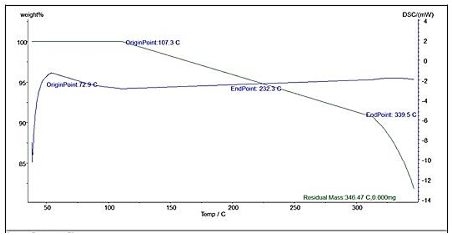
Especially, new peaks at 1651.07 cm⁻¹ and 1579.70 cm⁻¹ are present in the aromatic region in the reinforced sample, which are attributed to C=C aromatic bond stretching. The formation of these new peaks confirms that highly aromatic novolac rings are successfully incorporated into the polyester matrix. Moreover, new absorption bands are observed in the lower wavenumber region at 1124–1039 cm⁻¹ that are not present in the neat resin. The appearance of these new peaks is ascribed to the formation of chemical crosslinking between the polyester and novolac networks . Also, a strong peak at 3458.37 cm⁻¹ due to O-H bond stretching of phenolic hydroxyl groups of the novolac is clearly observed in the reinforced sample but less intense in the pure polyester. Both the spectra show high peaks at 1716.65 cm⁻¹ (C=O bond stretching) and 1255.66 cm⁻¹ (C-O bond stretching). However, the reinforced sample shows noticeable variation in the intensity and shape of these peaks as compared to the neat sample which further indicates changes and increased density in the polymer network. The thermogravimetric analysis (TGA) curve of a 1% novolac-reinforced sample during heat treatment at different temperatures shows that the sample starts with a slight weight loss at 72.9°C, which is due to the evaporation of moisture and residual solvents. This gradual weight loss continues up to 107.3°C, where the initial thermal decomposition of the short polymer chains and less stable components takes place. The weight loss of the curve starts to be significant at 232.3°C, which corresponds to the beginning of the main stage of the thermal decomposition of the unsaturated polyester network where hydrogen bonds and weaker crosslinks between the ester and the polymer chains are starting to break. The rate of weight loss is still high up to 339.5°C. Essentially, the major degradation of the organic polymer backbone is complete. The residual mass at 346.47°C is indicative of the char or inorganic matter content of the sample, which is negligible (~0.000 mg), suggesting the high purity and near complete thermal volatilization of the organic components in the reinforced polymer (Figure 11).
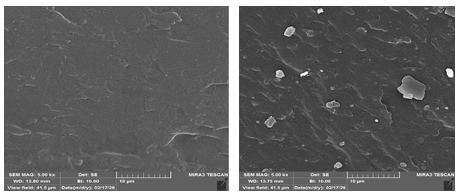
The variations of heat flux with temperature are shown in the Differential Scanning Calorimetry (DSC) curves. The direct com-parison of the neat (unreinforced) unsatur-ated polyester with the novolac-reinforced sample clearly shows a significant thermal enhancement. The (Tg) of the novolac-reinforced sample shifts significantly to 72.9°C with base line. This comparative increase in the glass transition temperature confirms the role of the novolac addition to increase the stiffness and crosslinking densities in the polymer network. The higher degree of cross linking restricts the move-ment of the polymer chains and therefore, more thermal energy is required to change from glassy state to rubbery state. One can observe a relative stability of the curve in the interval between 107.3°C and 232.3°C where the material is in a stable glassy state. The curve begins to decline slowly at approximately 232.3°C, indicating the beginning of the endothermic decomposition processes, decreasing to 339.5°C where the primary thermal degradation takes place [29] (Figure 11). The morphology of the pure unsaturated polyester and the novolac-reinforced sample is clearly different, as seen in Figure 12, which were obtained by scanning electron microscopy (SEM).
The surface of the pure material is relatively smooth and homogenous, which suggests a single-phase polymer structure without sep-arate phases. The novolac-reinforced sample is, however, found to have a distinctively heterogeneous morphology. The novolac particles are seen as bright white phases, and their size and shape range from small spheres to irregular masses, all dispersed throughout the polyester matrix. The novolac particles are clearly visible in the image, and the matrix is the UPE. The novolac particles are clearly visible in the image, while the matrix is the UPE. In addition, the surface of the reinforced sample is more rugged than the pure sample. Although this phase-separated morphology and the resulting mechanical interlocking and stress transfer are advantageous at optimal concentrations (e.g., 2.5%), the inherent heterogeneity typically found in the SEM micrographs demonstrates that at higher concentration (e.g., >3.5%), these separated phases have a tendency to agglomerate, creating stress concentration points and compromising the strength of the polymer network [ 30 ].
Conclusion The present work successfully proved that the novolac resin incorporation into the unsaturated polyester (UPE) significantly improved the mechanical and thermal properties, while the optimal performance is highly dependent on the novolac concen-tration. The most significant results demon-strate that the 1% novolac composition exhibits the best ambient mechanical performance with maximum values of approximately 830 MPa for modulus of elasticity, 120 MPa for compression strength, 86 Shore-D for hardness and 1.7 kJ/m2 for impact resistance. The optimum value was determined to be 2.5% novolac ratio for higher thermal stability requirements. At this level, the composite modulus of elasticity was doubled to around 1900 MPa at 50°C and showed a very high stability up to 150°C. The composite also exhibited an exceptional high temperature hardness with a maximum of 93 Shore-D at 50°C. The higher glass transition temp-erature (Tg) is attributed to the enhanced crosslinking density and the formation of new chemical bonds between the phenolic hydroxyl groups of novolac and the ester groups of the polyester, which is responsible for the superior performances confirmed by analytical techniques like FTIR, TGA, DSC and SEM. The material had a melting point of 72.9°C and showed a delayed thermal decomposition. However, it was conclu-sively found that the novolac content beyond 3.5% leads to phase separation and particle agglomeration which disrupts the stress transfer and degrades the mechanical pro-perties. In summary, these novolac-rein-forced UPE composites, especially at the optimal ratios of 1% to 2.5%, are highly suitable for demanding industrial appli-cations that require high mechanical strength and thermal stability, such as mold making, automotive parts, and electrical insulators.
References
|
||||||||||||||||||||||||||||||||||||||||||