|
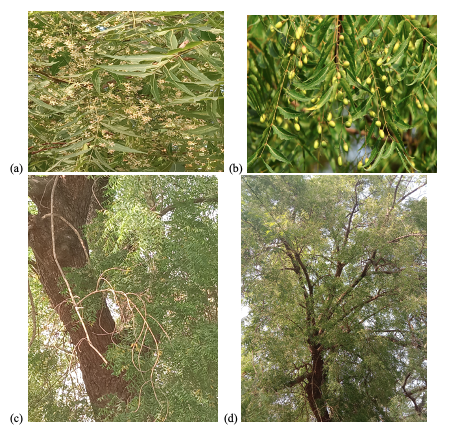
Introduction Plants parts, which include flowers, leaves, roots, stems, fruits, or seeds, are used widely for therapeutic purposes due to low accessibility and high cost of orthodox medicine. While some are used as prophylaxis, others are adopted for curing many types of illnesses. The remarkable number of reports on the therapeutic properties of medicinal plants, together with long-term experience in folk medicine, has led to a growing interest in the use of natural products [1]. Medicinal plants still hold promise as therapeutic agents because of the enormous number of plants around the world yet to be explored for their pharmacological potential. These plants produce a number of secondary metabolites as chemical compounds with important biological activities, such as antimi-crobial, anti-inflammatory, anticancer, anti- aging, antiviral, antioxidant, enzyme inhibitory, antihypertensive, and anticoagulant effects [2,3]. Cosmetics, on the other hand, defined by the European Commission (2015) as any substance or mixture intended to be placed in contact with the external parts of the 2 human body (epidermis, hair system, nails, lips and external genital organs) or with the teeth and the mucous membranes of the oral cavity with a view exclusively or mainly to cleaning them, perfuming them, changing their appearance, protecting them, keeping them in good condition or correcting body odors, play an essential role in our society today. Medicinal plants are used extensively today in drugs, cosmetics, and the formulation of skin care products for their reduced toxicity and ability to enhance natural beauty [4-6]. The application of seeds in food [7], health [8,9] and industrial sectors [10] cannot be overemphasized. Azadirachta indica, also known as neem, Indian lilac or Margosa, belong to the family Meliaceae, subfamily Meloideae and tribe Melieae [11]. Neem is the most versatile, multifarious trees of the tropics, with immense potential in herbal medicine and pharmacotherapy. It is widely distributed in the arid areas of several tropical and subtropical countries; it often grows to a height of 15–20 m with pinnate leaves of average 30 cm long and asymmetric leaflets often reaching 8 cm (Figure 1).
Neem leaves are medium to large in size and elongated to oblong in shape, averaging 20– 40 cm in length. The vibrant green leaves are smooth and glossy with sharp serrated edges. Neem leaves grow on the branches of neem trees in groups of two and each branch produces approximately eight pairs. The fruit is smooth, ellipsoidal drupe, sometimes up to 1.5 cm long, comprising of sweet pulp enclosing a seed. Neem possesses more useful non-wood products (leaves, bark, flowers, fruit, seeds, gum, oil and neem cake) than any other tree species. These non-wood products are known to have antiallergenic, antidermatic, antifeedant, antifungal, anti-inflammatory, antipyorrhoeic antiscabic, cardiac, diuretic, insecticidal, larvicidal, nematicidal, spermicidal and other biological activities. Neem and its products have been widely reported to control insect pests [12]. The seed is composed of a shell and a kernel which is the source of the oil that is highly medicinal in nature. The seed oil is used directly as an insect and mite repellent, worm expellant, insecticide, and fungicide when diluted to various concentrations and mixed with other substances [13]. Neem is used to treat dermatitis, eczema, acne, bacterial and fungal infections, and other skin disorders. The paste made from the neem or seed oil is used for treating acne, eczema, impetigo, ulcers, pustules, snake and scorpion bites, chicken pox, measles, scaly scalp, psoriasis, pruritus, dermato-phytosis, leprosy, pediculosis, and scabies [14]. The leaves are dried and burnt as insect repellant. The extract is used to improve the immune system and also as an anti-inflammatory agent in skin disorders [15]. The use of seed oils and other organic products in green cosmetics has gained more attention recently. This is because many scientific outputs reportedly have linked rashes, skin discoloration and allergic skin irritation to many synthetic additives used in cosmetics [16]. Hence, the need for green preparation of cosmetics cannot be over-emphasized. This work reports the characterization of neem seed oil, the formulation of an organic cosmetic product and anti-inflammatory evaluation.
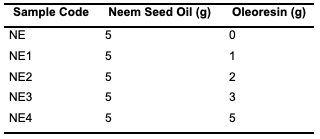
Materials and Methods The high purity reagents were obtained from SigmaAldrich, Inc. (Missouri, USA) and were used as received without further purification. Other chemical and reagents used were analytical grade, while solvents which include n-hexane, ethyl acetate, chloroform and methanol were re-distilled before use when required.Collection and Preparation of Plant Samples The seeds of the neem plant were collected from fruiting trees within the Ilorin metropolitan area and were authenticated by a taxonomist at the herbarium of Plant Biology Department at the University of Ilorin. The seeds were dried at ambient temperature, de-shelled, pulverized and were kept in a cool dark place for further work. The oleoresin used for the fortification of the seed oil was obtained as a gift for the Medicinal Chemistry Research group of the Department of Chemistry. Solvent Extraction of Neem Seed Oil The pulverized neem seed was weighed (413.53g) and subjected to Soxhlet extraction using n-hexane until exhaustion, then filtered and concentrated to obtain the oil. Lipid Transesterification The oil obtained was trans-esterified by treating 2 g with 0.2 M methanolic HCl (60 mL) [17]. The mixture was refluxed for an hour and allowed to cool. The organic layer was separated from the aqueous layer using a separating funnel. The organic phase was washed with water, dried over anhydrous magnesium sulphate, and then concentrated to afford the fatty acid methyl esters (FAMES) and stored for GC–MS analysis. The percentage yield (% w/w) of oil obtain (30.02%) of the trans-esterified oil was determined using the formula (equation 1): Saponification Value One (1) gram of each oil was weighed into a conical flask containing 25 mL of methanolic KOH and mixed together. The mixture was warmed in a water bath for 5 min, 3 drops of phenolphthalein were added to it, and the content titrated against 0.5 M HCl until the pink colour disappeared. The discolouration indicates the end point. The saponification value was calculated using the equation (2): where SV = saponification value; B = blank titre value (mL); S = sample titre value (mL); M = Molarity of KOH, taking the molecular weight of KOH to be 56.1 g/mol. Acid Value One (1) gram of the oil was weighed into a flask with 25 mL of methanol and 3 drops of phenolphthalein indicator was added to it. The mixture was warmed in a water bath for 5 min and titrated against 0.1 M KOH until the pink colour disappeared, which indicates the end point. Acid value was calculated using the equation (3): where AV = acid value; M = Molarity of KOH. Peroxide Value The oil (0.5 g) was weighed into a conical flask containing 1 g potassium iodide. The mixture of glacial acetic acid (13.5 mL) and chloroform (6.5 mL) was added to it. The solution warmed in water bath for a minute, 20 mL of 5% potassium iodide and 25 mL of water was added to the mixture. Sodium thiosulphate solution (0.002 M) was titrated against the content to colourless using freshly prepared starch as indicator. The results were expressed in mMol/Kg. The peroxide value was calculated using the formula: where Vb = titre for blank; Vs = titre for sample; M = Molarity. Green Seed Oil Fortification with Oleoresin The seed oil was fortified with oleoresin originally obtained from the stem bark of the Danielli oliveri plant using the formulation indicated in Table 1.
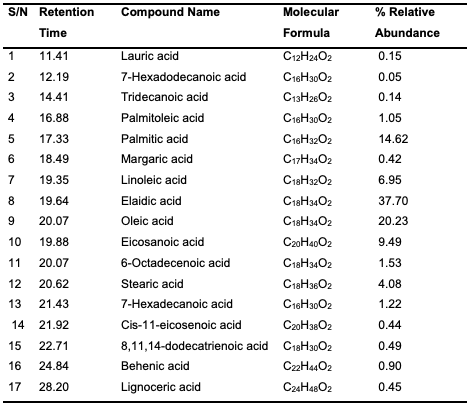
Results Neem Seed Oil Chemical Profiling The results obtained from GC-MS analysis of the trans-esterified neem seed oil are as depicted in Table 2.
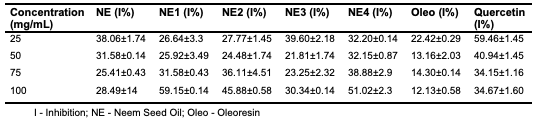
In vitro Anti-inflammatory Activity The anti-inflammatory activity of the oil was evaluated using the albumin denaturation assay. The results obtained are as depicted in Table 3.
Discussion The GC-MS analysis of the neem seed oil confirms the presence of constituents which are known to exhibit medicinal as well as physiological activity [18]. Characterization of the fatty acid profile of neem seed oil is vital for industrial and economic purposes. The GC-MS results showed the presence of major fatty acids including palmitic acid (14.62%, 17.33), a saturated fatty acid, elaidic acid (37.7%, 19.64), oleic acid (20.23%, 20.07), linoleic acid (6.95%, 19.35), eicosanoic acid (9.49%, 19.88), and stearic acid (4.08%, 20.62). The profile revealed the presence of more long chain fatty acids than the short chain fatty acids. The lower amounts of stearic acid and linoleic acid observed in this study could be attributed to different factors such as seasonal variation, time of harvesting, growing conditions and other biotic and abiotic factors. Eicosanoic acid is known to be useful in cosmetics formulations while docosanoic acid, also called behenic acid (C22H44O2), is often used as hair conditioners and moisturizers, giving them smoothing properties [19]. The anti-inflammatory properties of the oil and the fortified products revealed a dose-dependent albumin denaturation inhibition potential comparable to the standard, quercetin. While the oleoresin showed low dose-dependent activity, the fortified products exhibited better activities reflecting potential synergistic activity of the oleoresin with the oil. The composition of the neem oil indicates a rich mixture of saturated, monounsaturated, and polyunsaturated fatty acids. This diverse composition makes neem oil suitable for various applications in cosmetics and skincare due to the presence of oleic and linoleic acids which are required for skin moisturizing and nourishment. The presence of the lauric acid will enhance the antimicrobial properties in cases acne and other skin infection conditions. Moreover, the pharmaceuticals potential will be enhanced due to the presence of significant amount of linoleic acid known to possess anti-inflammatory properties. Fatty acids are crucial components of oils and fats, and their composition can significantly influence the properties and applications of the oil.
Conclusion Neem seed oil, investigated for its chemical composition, has been formulated into a green cosmeceutical product with potential anti-inflammatory activity. The formulated product, devoid of all synthetic and artificial additives, revealed the potential application of the oil in organic cosmetics. As most cosmetic consumers now prefer herbal, organic, or green cosmetic products which are less toxic and more environmentally friendly, the application of the seed oil for use in cosmeceuticals is hereby reinforced. Neem seed oil, often discarded as waste, holds tremendous promise as a viable and sustainable source of bioactive oil for affordable organic cosmetic formulation. Owing to the results obtained in this study, coupled with the abundance of neem seeds in the study area, production of viable oil from neem seeds is highly recommended for further investigation as a source of raw material for cosmeceutical industries. The chemical composition of the neem seed oil highlights its versatility and potential for various applications. Its rich blend of fatty acids not only supports its traditional uses but also opens up new possibilities in modern industries.
Conflict of Interest: Authors declares no conflict of interest.
References
|
||||||||||||||||||||||||||